Yeah, why don’t you hit play right there? You’ll thank me later.
Picture this. It’s the early 2000s. You’re in an overstock store perusing the racks of discounted media. You’ve found some good stuff here before, the things that other stores couldn’t sell or bought too many of. You clear a passage in one of the bins, through sedimentary layers of Christian rock albums and Canadian sitcoms that ran for less than a season. That’s when you find it.
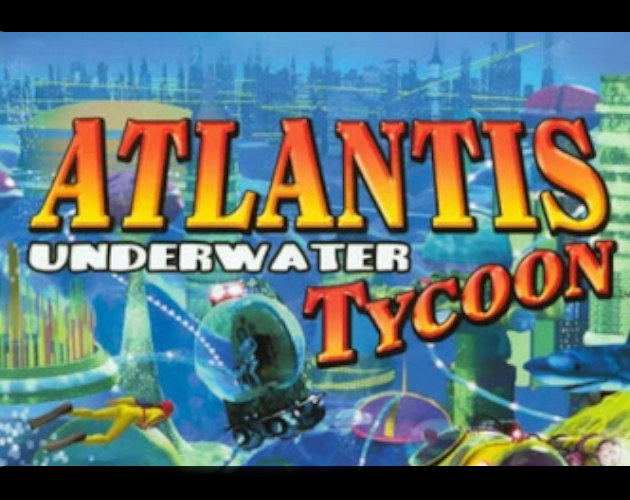
The package is large, much larger than it really should be. It’s the size of a cereal box (I regret, though, that I’ve been unsuccessful in finding a picture of this packaging), but it’s for a computer game. It catches your eye. A big, square box featuring an underwater city, divers and sea creatures.
This is how I first came into contact with Atlantis Underwater Tycoon. And if you’re brain broken like I am—I mean, hey, what are you doing here if you aren’t?—and you, too, have played this game, you probably have a similar story.
I played it like mad because it just so happened to meet the specs of the 1990s Gateway my cousin gave me, but the game is so-so. By today’s standards, it’s clunky and awkward, but more than two decades of nostalgia imbue it with a sort of charm.
The game was ambitious. You take the role of an administrator/mayor in charge of building out an undersea civilization; from tropical shallows to abyssal plains. Even a volcanic setting, which I didn’t care for too much because it creeped me out.
These are neat features, but what drew me back in—and by that, I mean undergoing the byzantine process of partitioning my hard drive on my Apple computer, installing Windows, buying a version of the game, installing it, and navigating multiple system folders to find one lonely file—was not for the gameplay, which, as I’ve said is sorely out of date, but for the music.
The soundtrack lays somewhere between 80s synthesizers and Paul Oakenfold. It’s atmospheric and relaxing [hopefully you’re listening to it now, but if you’re not, go hit play at the top].
But where the hell did it come from and who made it? Let’s get into it.
Lost Composers
In 2003, a Los Angeles-based studio called Anarchy Enterprises released Atlantis Underwater Tycoon, the first city-building sim set on the ocean floor, or so its developers claim.
Confusingly it was also released in some places as “Deep Sea Tycoon.” Some people will tell you it’s not the same game, but they’re wrong. It is.
It was a budget title, the kind sold in jewel cases at big-box stores—or if you’re like me, in a T.J. Max bargain bin—for twenty bucks.
It didn’t change gaming, but it had a genuinely good score. Reviewers noted the techno soundtrack. Worthplaying called it an “excellent score,” praising how the music shifted with the time of day, quieter at night, more driving during missions. GameWatcher commended its “snappy music track.” Even on TV Tropes, the game’s four looping themes earned an “Awesome Music” nod.
And yet, for more than twenty years, nobody seems to know who made it.
The game’s files offer no clues. The music tracks pulled from the disc carry no composer metadata, no copyright tags, nothing. The in-game credits are no help either, and contemporary coverage never named a composer.
The trail, such as it is, runs through MobyGames, the archival database of game credits. There, the full credits for Atlantis Underwater Tycoon list a single combined entry: Epilogue, Jarrod Malek, Takemura Miho, and Jason Sullivan. Four names, one line, no further breakdown of who wrote what.
Of the four, only one has a footprint. Jarrod Malek was Anarchy’s audio man, credited on eight of the studio’s games. He did sound editing on the studio’s 2001 release Moon Tycoon, sound on 2008’s Redrum, and co-composed the music for Hide & Secret: Treasure of the Ages alongside the Norwegian game composer Bjørn Lynne.
The pattern across Anarchy’s catalog is consistent. Malek handled sound in-house while the music was farmed out to a different composer or studio on nearly every game. Moon Tycoon‘s music is credited to the alias Proof-X. Deep Sea Tycoon: Diver’s Paradise used Lynne and two others. Atlantis, it seems, used Epilogue.
Anarchy likely contracted the score out to an audio studio. Which studio, exactly, remains unclear. Takemura Miho and Jason Sullivan, the other two names on the line, have no verifiable trail in game audio at all.
So the mystery is half-solved. We know the names, but the music’s true authorship is still blurred inside a single credit line.
What is for sure, though, is that the music rips.
The Bottom Line
You can still buy Atlantis Underwater Tycoon—sometimes for very cheap. The gameplay is mediocre by today’s standards. So unless you’re after a nostalgic fix, best avoid. But do pick it up if you want that sweet, sweet .wav file (as far as I can tell, it isn’t available to stream anywhere), best to not wait and dive in.


Leave a Reply