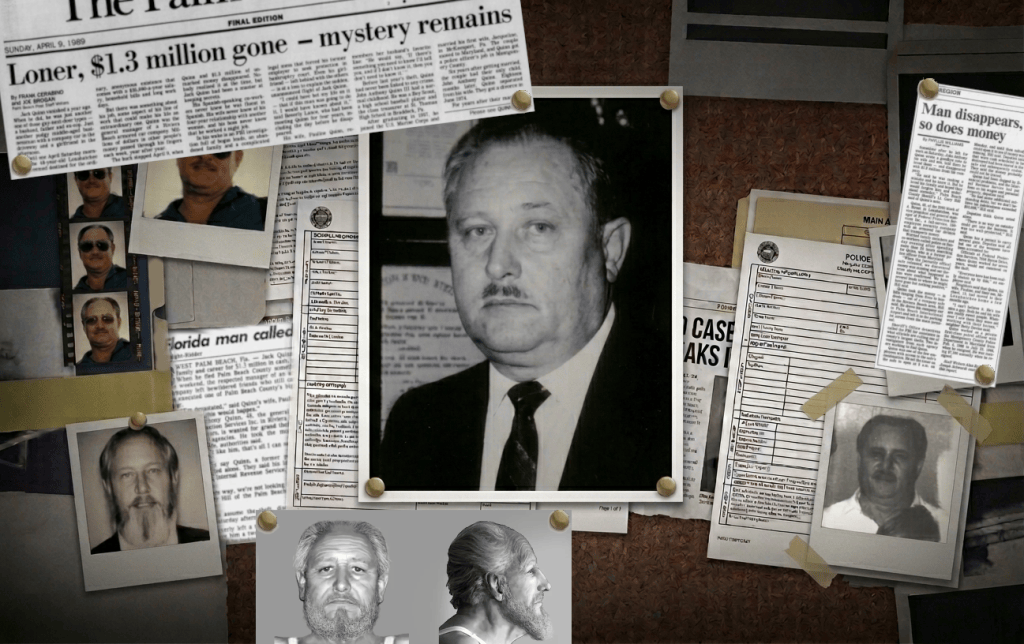
The case of John Anthony Quinn, and the ruined lives he left behind
Part I – Please Forgive Me for My Actions
When Pauline Quinn looks at the clock in the kitchen and her husband, Jack, hasn’t returned home, she knows something is wrong.
It was a typical warm and sunny Saturday at the Quinn household in Loxahatchee Groves, Florida, a community west of Palm Beach where suburban South Florida butts up against the Everglades.
But it’s getting cool now, well cool for Florida—it is April, after all. The shadows stretch out from the sycamores, magnolias and even a thatch palm or two, which once seemed so new and alien just a few years ago.
True, it’s getting late. But Jack has an important job. He’s the vice president of FPS, a security firm, and he leads their armored car division.
It’s custom for him to go in on Saturdays to check the deliveries, and the safes. But he never stayed out this late before. She’s not worried yet, but drifts out of the placid security of a housewife on a horse farm.
First, Pauline phones Jack’s coworkers. When they tell her they haven’t seen him, that isn’t quite the cause for concern. He’s not close with any of them. So she calls his boss, Carl Fulgenzi.
But Carl tells her he hasn’t seen or heard from Jack today.
Now Pauline is worried.
She calls the police to see if Jack has been involved in an accident, but authorities didn’t see him either.
Jack sometimes comes in around midnight. But that’s only during the work week, when things at work need his attention, he tells her. But he’d never stay out this late on the weekend. He likes to come home and watch TV.
An uneasy, sleepless night ensues.
On Sunday, Pauline goes outside to check the family car for clues. Jack came back on his lunch break Saturday, hitching a ride from a coworker before he went back to finish up. That was strange, because he usually takes his company car, a white Chevrolet Chevelle.
Jack said something was wrong with it and rode back to the office.
Pauline doesn’t know why she thinks something would be in the family car, but she checks it anyway.
She checks the sun visors and the glove compartment. She checks between the seats and under them.
Nothing.
Then she opens the trunk.
Inside, she finds two sealed bags. One contains a note. It reads:
“Please forgive me for my actions. I hope you’ll understand someday. I love you.”
It ends with instructions for their son, 13-year-old Michael, including for him “to be the man of the family.”
This sends Pauline into a spiral of panic.
She frantically opens the second bag. Inside this one are stacks of cash, bound in rubber bands.
She takes them out. The bills are old and tattered, the denominations of so many presidents worn to the point she couldn’t read the amounts. But they’re legal tender.
Later, authorities tally the sum to be around $107,000.
Pauline drops the bundle of cash back into the bag, like it might bite her. She slams the trunk and starts reciting Hail Marys and Our Fathers.
She goes inside and then comes back out, pacing, maybe biting her nails, too stunned to believe what’s happening.
“I tell you, no one could know him better than me,” Pauline tells reporters later. “I’m his wife, and I had no idea how this could happen.”
The money, according to Jack’s note, was to take care of his wife and child, but Pauline immediately turns it back over to FPS.
Pauline knows Jack is making a mistake, which is why she calls his boss Carl again to tell him what she found.
“Because one stupid mistake was made, there’s got to be two? I have my pride and my integrity and my son, and I’m not going to do anything to jeopardize them,” she says.
Carl immediately goes to the FPS office in Palm Beach, where he finds evidence around the office suggesting that Quinn had fled and took a large sum of money with him, and alerts authorities.
The Palm Beach County sheriff’s office then calls the local FBI office for assistance.
Authorities gather sufficient evidence from the scene at FPS to establish that Jack might have robbed the company and fled. But they need confirmation before they can launch a full investigation. The only problem is that proof hides behind a steel door to a safe of which only Jack knows the combination.
Luckily, the safe runs on a time lock, a feature that Jack implemented—Jack designed the entire security system for the whole armored truck division. The time lock would expire Monday morning.
Another anxious, sleepless night.
Pauline holds out hope that maybe this was all a misunderstanding, a prank even. Maybe someone put Jack up to it. She harbors any other possibility than the one authorities are telling her.
No, Jack would come back and explain it all and everything would go back to normal.
But he doesn’t.
Night gives way to morning.
A solemn group of FPS employees, deputies from the Palm Beach County sheriff’s office, and FBI agents gather around the company safe.
When the safe opens at 5:30am, the suspicions are confirmed. When an accounting is complete, a sum of $1.3 million is missing. At the time, this makes it one of the largest thefts in Florida history.
The money is in denominations ranging from fives to hundreds, enough to fill a large suitcase, authorities surmise.
Later, police locate Jack’s car, the white Chevelle. It’s parked at Palm Beach International Airport, in a lot across from the main terminal. Parking records showed the vehicle had been left there Saturday evening.
Jack really is gone.
“I’m devastated. No one could know this would happen.” Pauline says, surrounded by law enforcement and reporters.
This can’t be happening, Pauline thinks. Her and Jack’s marriage is ideal. He would never abandon her or their son. She tells people that, and how could it not be? It started off that way.
Part II – If There’s Something You Need to Know
It’s 1972. Pauline is in a park in Maryland, on a picnic with her three children. That’s when she sees a policeman on horseback.
The horse trots over to her and the officer meets her gaze. He stops in front of them and welcomes Pauline’s children to come up and pet the horse. He’s a bit rotund, but he has a warm smile and blue eyes.
“I guess you could say it was love at first sight,” Pauline says, recounting the day years later, after Jack fled with over a million dollars in stolen cash. “I guess that doesn’t sound very nice now.”
Pauline and Jack were both married to other people at the time, but after meeting in the park, they quickly got divorces and were married in 1974.
Their son, Michael, came along a year later.
Over the years, she learns a bit about her new husband.
Born John Anthony Quinn III, Jack grew up in Braddock, Pennsylvania. In high school, he was a baseball player and a member of its Spanish-language honor society.
Afterword, he joined the Marine Corps. He volunteered for an elite reconnaissance unit, where he practiced jumping from planes and invading beaches in submarine-launched boats. He was even put on standby to deploy to Lebanon during the conflict in 1958, an order that never came.
To this day, he keeps in good shape with swimming and exercises, as though he might be recalled at any minute.
Still, Jack doesn’t play the role of a tough guy. He’s quiet and reserved, and rarely drinks. He doesn’t socialize much. He doesn’t have many friends and keeps coworkers at a distance. He rarely leaves the house except to go to work. Mostly, he likes to be at home and watch TV.
Jack stays in the police force for a few years, but for reasons that aren’t quite clear, he quits. The new family hops around the East Coast while Jack works odd jobs before they all return to Maryland.
In 1982, though, Jack decides to move the family to Florida.
He takes up a series of jobs, but eventually lands at a security company called Merchants Armed Transport, and buys a home in Wellington.
While at Merchants, Jack rises up to head their armored car division. But then the company suffers several internal thefts. They’re never solved, and then it goes bankrupt.
Another company, called FPS, absorbs Merchants.
Jack takes to the new company well, and he’s hired on to manage their armored car division as well.
He works odd hours at FPS. Pauline thinks maybe that comes with the territory.
He leaves early, sometimes at five in the morning, and frequently comes back home late in the evening. Lately, he’s been coming in after midnight, but that’s only during the week.
Those long hours pay off for the family when Jack is made vice president of FPS, though.
And in early 1988, Jack gets his family a new home. It’s in Loxahatchee Groves. It’s a rental, but it’s located on a farm, and comes with facilities to house 25 horses. He also buys a second car.
Jack carries himself more confidently now. He wears flashier clothes and always smokes a cigar. He lets himself go a bit.
But there are a few things Pauline notices over the years. When his mother died months before he disappeared, Jack hardly reacted.
“Not once did I see a tear,” she says.
Jack also never brings up his old life. Sure, who’d want to talk about an ex-spouse, let alone speak with them? But he has five other children, and he hasn’t said a word to them—or about them—in years.
“I knew the man so well, but what got me the most was that his innermost feelings were hidden from me,” Pauline says.
Jack tells Pauline he pays alimony and child support, but one day police arrive at their home and threatened to have him arrested if he doesn’t pay.
And then, in 1986, the police arrest him for not paying it.
Things are suddenly going wrong. When Pauline tries to get answers from Jack, all he says is:
“If there’s something you need to know, I’ll tell you. And if I don’t know it, then you don’t need to know it.”
After the arrest, Jack acts different. He’s more on edge, and spends less time at home.
He loses weight.
He smokes less.
And then he shaves his mustache.
After what seems like something building up, it passes. Jack is more relaxed. He goes back to his old self, more of the image he’d been when Pauline met him.
Then he gets up early on a Saturday morning, like he usually does, and goes to work for a bit.
When Pauline waves goodbye to him from the kitchen window, that’s the last time she sees him under any circumstances that could again be called normal.
Part III – They Don’t Know Jack
Days pass.
Weeks pass.
The summer comes and goes. But the police don’t find jack, literally.
At first, they think he boarded a plane. They find through airline records that Jack bought three tickets to three different destinations.
Investigators think he did this to intentionally throw them off. Jack probably didn’t board any of them, and used a fake name on the one he did.
Another theory is that he bought the tickets as a red herring, and that he rented a car and just drove away.
In lieu of the man, the police start looking into his background.
One of the things they learn is that Jack spoke fluent Spanish. The police piece that one together because he’d been in the Spanish honor society in high school.
But Pauline never heard Jack speak Spanish, ever. Nor did any of Jack’s Spanish-speaking coworkers. But the FBI and the police run with it, and say that he fled somewhere south of the border.
They get a few leads of men who look like Jack carrying around luggage with large sums of money. But they turn out not to be Jack. Just run-of-the-mill drug mules and dealers.
Yes, the man who spent all of his nonworking hours in front of a television set was now smuggling himself between villages in casitas in some rural part of Latin America.
The police not only failed to find jack, they didn’t know jack either.
Other things they find, though, are more concrete and harder to swallow.
Jack, it turned out, had large debts—about $50,000—mostly to the IRS, which had been garnishing his wages and put a lien on his personal property, including the Quinn’s former home in Wellington. That explains their move into a rental.
He was also behind on child support payments to his ex-wife by nearly $10,000.
Jack made $35,000 a year at FPS. Not bad at all for 1988—the equivalent of nearly six figures in 2026.
But Jack’s ex-wife tells the press that he liked to spend beyond his means, and that it caused problems all through their 14-year marriage.
Jack had also been working part-time jobs at night. As a clerk at a liquor store and hauling medical waste from a hospital. That explains the late nights.
The IRS started tightening the screws on Jack for three weeks before he disappeared, which makes the police think he’d been planning the heist for about a month. That explains his strange behavior.
Pauline hates the IRS now, and blames the agency for causing her husband to do what he did.
Authorities say that plenty of people have tax problems, and most people deal with it rather than running away.
The police also think Jack had stolen before. The burglaries at his previous employer were never solved, and now they say Jack stole that money, too.
All these things the police tell the press and the public, it’s like they’re trying to get under Pauline’s skin.
The sheriffs want him for grand theft. The FBI wants him for interstate flight. But Pauline thinks they’re describing someone else, not Jack.
All of the things they say, though, are forgivable. Pauline could accept them, if they were proven to be true.
But there was one thing Pauline wasn’t ready to hear. Of all of Jack’s skeletons being aired publicly in the months after he disappeared. Maybe one she suspected, but one she didn’t want confirmed.
Over the course of the investigation, police discovered that Jack had been seeing other women, and that Jack may have fled with one of them.
Pauline never needed much. She’s in her 50s, and most of those years she’s been a homemaker.
There isn’t much information about Pauline. Where she went to high school, what she wanted to do with her life. She’s a wife and mother. Once before to one man and three daughters, and again to another with one son. That’s all people really know. That and she dyes her hair blonde.
Pauline never needed much. One half of her world was her children, the other her husband. Without one, she’s adrift.
People don’t know jack. Maybe, Pauline thinks, she doesn’t either.
Part IV – An Eye for Other Women
Her name was Beverly Lance.
She met Jack while she worked for a company that provided telephone answering services for area companies, including FPS.
Jack met her in the mornings and in the afternoons. Sometimes, Jack’s coworkers said, they would tease him when he left at noon and came back as late as 2 or 3pm some days.
Jack would tell them he had meetings or he took a long lunch. Most of the time, though, he was with Beverly.
The police seem all too happy to tell Pauline this, like they’re taking their frustrations out on her since they can’t take it out on Jack, wherever he is.
It wasn’t just Beverly, though. Jack’s boss tells the press that his former vice president had an eye for other women. He said he’d go crazy any time a girl came into the office, and he’d disappear for hours at a time with them.
But Jack didn’t flee with Beverly. She remains in Palm Beach.
But the police seem to twist the knife. They tell Pauline that of all the secrets Jack kept, maybe a second girlfriend wasn’t such a stretch. He only saw Lance in the afternoons. That left his mornings open, for another girlfriend.
A girlfriend who’d run away with him.
Pauline is distraught by this news, so much so she attempts suicide.
The confirmation of Jack’s transgressions, almost more than anything else, did more to demolish the fiction Pauline carefully constructed around herself. And now the real one was barging its way in.
Part V – Forking It Out
People say a lot of the same things in the wake of shocking events, Pauline finds.
“This isn’t like him,” one of Jack’s coworkers says.
“Everyone here has been really shaken up by this,” says another.
“What prompted this, I don’t know,” says his boss, Carl Fulgenzi.
“Every time I see him he’s always very friendly and seems real happy,” an employee at a business next door to FPS says.
“I can’t believe it. He’s too nice a guy. Both he and his wife are really sweet people. Whenever I saw them they were out working with their horses,” a neighbor says.
Friends and neighbors described Jack as a kind, family man. He “worshipped”—their word—his 13-year-old son, Michael.
“My daddy loves me, and he’ll be back for me,” Michael says.
Everyone is always surprised when something like this happens. But once the shock wears off, something changes. People reassess. They were never surprised, really. In fact, the signs were always there. Maybe they’re true.
No marriage is perfect, but Pauline says her marriage to Jack was ideal, and she means it.
“Why would he cheat, then?” Lance tells reporters when they describe Pauline’s accounting of her and Jack’s domestic life.
That comment seems to open the bidding on all the family’s friends and neighbors to begin airing anything they knew about them.
Their landlord, who rented the Quinn’s their home at $1,200 per month, says their marriage was bad and they were always fighting. Many of their neighbors attest to the same thing, recalling loud, sometimes violent arguments between Jack and Pauline.
“I couldn’t believe he was forking it out for a woman who was making him so miserable,” the landlord says.
About two weeks before he disappeared, the landlord spoke with Jack. The landlord had just came back from a vacation in Western Canada, and Jack asked what language they spoke. And whether they have TV.
Part VI – The World Has Crumbled
The house in Loxahatchee Groves is a rental.
So when Jack, the sole provider for his family, disappeared, so did his family’s only means of support.
Pauline gets by for a little while on the charity of others. First asking for money to try and make ends meet, and then just for food to feed her son.
But as the case draws on, as it got more attention, people began turning her away. They don’t want to associate with the wife of a criminal, it seems.
“I’m being shunned,” she says. “I have nobody to call a friend.”
The Quinn’s neighbors and friends don’t want Pauline and Michael around anymore. Less than a month after Jack disappears, they get their wish.
In May 1988, Pauline and her son leave their home in Loxahatchee Groves, and move back to Maryland.
Pauline moves in with her daughter from her previous marriage, Denise, one of the children who came up to pet Jack’s horse all those years ago.
Their living arrangements are different now. No longer on a horse farm in Florida, on Jack’s comfortable salary and two cars. They now live in a Washington D.C. suburb, living on welfare and the good will of family members.
But the arrangement doesn’t last long.
While Pauline is out at the store buying things for a Memorial Day party, Denise is strangled to death by her husband.
It’s around here that Pauline starts to wonder if something happened that day she met Jack, like their meeting, marriage and life initiated some sort of curse on her and her family.
Four years after marrying Jack, her other daughter, Dale, is killed in a car crash along with two other people on a road trip in New York State.
Ten years later, she’s burying a second child.
“Oh my God, the world has just crumbled down on me,” Pauline says.
Still, she holds out hope that Jack will come home and everything will go back to normal.
“Every waking moment all I think about is, Where are you, Jack? You wait for the mailman, and nothing comes. You stay up till 3 in the morning. Please get in touch with us, Jack. We need you, Jack. Do you know where we are? Why did you do it, Jack?”
Despite the hardship, Michael still admires his father.
“He’s done something no one else could get away with,” he says.
Part VII – Comings and Goings
Later that summer, just months after Jack disappeared, Pauline and Michael move into a trailer in Ocean City and live off a meager welfare income.
Nothing changes.
Two years pass.
And then a letter arrives.
One day, Pauline returns home. She goes to make something in the microwave, only to find something is already inside.
She takes it out. It’s a handwritten letter, from Jack.
The letter comes with a package. She opens it. It’s $3,600 in cash. The same kind of tattered bills she found in the family car in 1988.
Pauline, telling a reporter the story years later, can’t recall what the letter said, or what she did with the cash, because she was soon parted with them.
Upon receiving the letter and learning who it came from, Pauline gets so excited, she tells her neighbor about it, and the money.
The next day, the letter and the money are stolen.
But this isn’t the only time Pauline would see her husband, or the last.
Pauline admitted years later that she and Michael met Jack at the National Zoo in Washington, D.C., in 1989.
Inside his car, Jack traveled with beards and wigs. He went by the name Dale Clukey—the name of Pauline’s brother—he wore contact lenses to make his eyes appear brown, and gained a lot of weight.
Pauline said she never heard from Jack again after this meeting.
But then there was the letter and the money.
And then, later, Pauline admitted she admitted to having spoken with Jack on the phone in 1990.
It’s for these reasons the FBI thinks Pauline knows more than she lets on, and even suspects she and Jack lived together in 1989.
In 1992, the FBI tracks Jack to Houston. They discover that in 1989, he was issued a driver’s license in Texas, under the name Dale Clukey.
Despite an extensive search, the FBI is unable to apprehend Jack.
Jack told Pauline later, in one of those phone calls that he didn’t want to be taken alive.
Authorities doubt how long Jack can keep up being on the run, living on a substantial but limited amount of cash.
“The case will be open,” the FBI says. “Until we have either Quinn or his body.”
Part VIII – Life Has Been Hell
By May 1990, things aren’t going well for Pauline.
She and Michael return to South Florida for the first time since Jack disappeared two years earlier.
They’ve been living on welfare in Maryland. They have little money and no home. She returns with the hope of selling her story to a magazine, but it turns her down.
So she rents a motel room in Palm Beach until what little money she had runs out. It won’t be long. Pauline drinks and smokes almost constantly.
Over the years, she’s hardened on the decision to turn in the $107,000 Jack stole and left for her, and now wishes she would’ve kept it.
“People say, you must have gotten a reward,” she says, her bleached blonde hair unkempt. “I got nothing, absolutely nothing.”
Despite her hardships, Pauline continues to stand by her husband. “He was the most honest man anyone would want to meet,” she tells a reporter between cigarettes and glasses of rose wine in what would be her final interview. “Honesty was his first, middle and last name.”
Michael, now 15 and with long hair, snickers at this comment. “He’s not my father anymore,” he says. “He left us.”
Pauline still struggles with her husband’s disappearance, but her misery draws from many sources. She also grapples with the death of her daughters, Dale and Denise.
The list of Pauline’s ails continues: the previous summer, she suffered a severe heart attack that left her unable to work. And days before returning to Florida, she was in a motorcycle crash that badly hurt her leg.
“It’s been one fiasco after another. Life has been hell, to say the least,” she says. “And people wonder, why am I drinking?”
In the intervening years, Michael goes on to live with another family in Boynton Beach.
Meanwhile, Pauline is arrested and jailed for theft, and may have been driving a stolen car. A rumor circulates that she was checked into a rehabilitation clinic near her son to deal with her drinking problem.
Life does not get easier on Pauline.
After their brief stint in Florida, she and Michael move, yet again, back to Maryland.
At some point after returning to Maryland, Pauline enters a nursing home in Cumberland, where she dies in 1999 at the age of 59.
Part IX – Standards of Procedure
In early winter 2025, an old man arrives at Mission Hospital in Asheville, North Carolina.
There is no mystery about the state of the man’s condition, nor his prognosis.
The man, Jim Klein, is 86-years-old. There’s not much doctors can do for him except keep him comfortable. He’s simply reached the end of the line.
Not long after Klein arrives, he dies of natural causes.
What happened immediately after Jim Klein’s death is not known publicly. Medical records are shielded by a steel trap of privacy laws. But according to North Carolina law, standard procedures state that following a death, hospital staff are instructed to verify the identity of the deceased, so they can complete a death certificate.
Klein didn’t arrive with proper identification, so he requires postmortem fingerprinting. That’s not completely uncommon in major medical centers, especially in Western North Carolina.
The surrounding hillside wilderness makes it easy for people to fall through the cracks of the system—or evade law enforcement.
Hypothetically, the hospital notifies the Buncombe County Medical Examiner’s office or the Asheville Police Department to complete a full set of postmortem fingerprints. Authorities would then submit an electronic record of Klein’s fingerprints to the North Carolina State Bureau of Investigation, which checks prints against state and federal databases.
This is where the public record picks up again, because Klein’s fingerprints make it to the FBI’s Next Generation Identification (NGI) system. The NGI cross-references finger prints with millions of records that include historical criminal files, fugitive warrants, and unsolved cases.
In this instance, the system flags a match: a warrant for the charge of grand theft and interstate flight that allegedly occurred in Florida in 1988.
In March 2026, the FBI officially ended a decades-long hunt, concluding that the man who died in an Asheville hospital the previous December as Jim Klein was confirmed to be none other than John Anthony Quinn III.
Jack evaded capture for nearly 40 years. He kept a version of freedom, likely living in the North Carolina wilderness or just drifting through the area, under an assumed name, in a wig or in contacts, paying for only what he needed in cash.
He likely kept a good portion of his fortune, since he could no longer afford to be as flashy as he had been in his former life. What happened to the money is not known. Maybe he blew it all on a craps table in Vegas, maybe he stashed it away somewhere. Maybe he sent it to someone.
In the end, Jack kept his freedom and his money. It just cost him everything else.


Leave a Reply